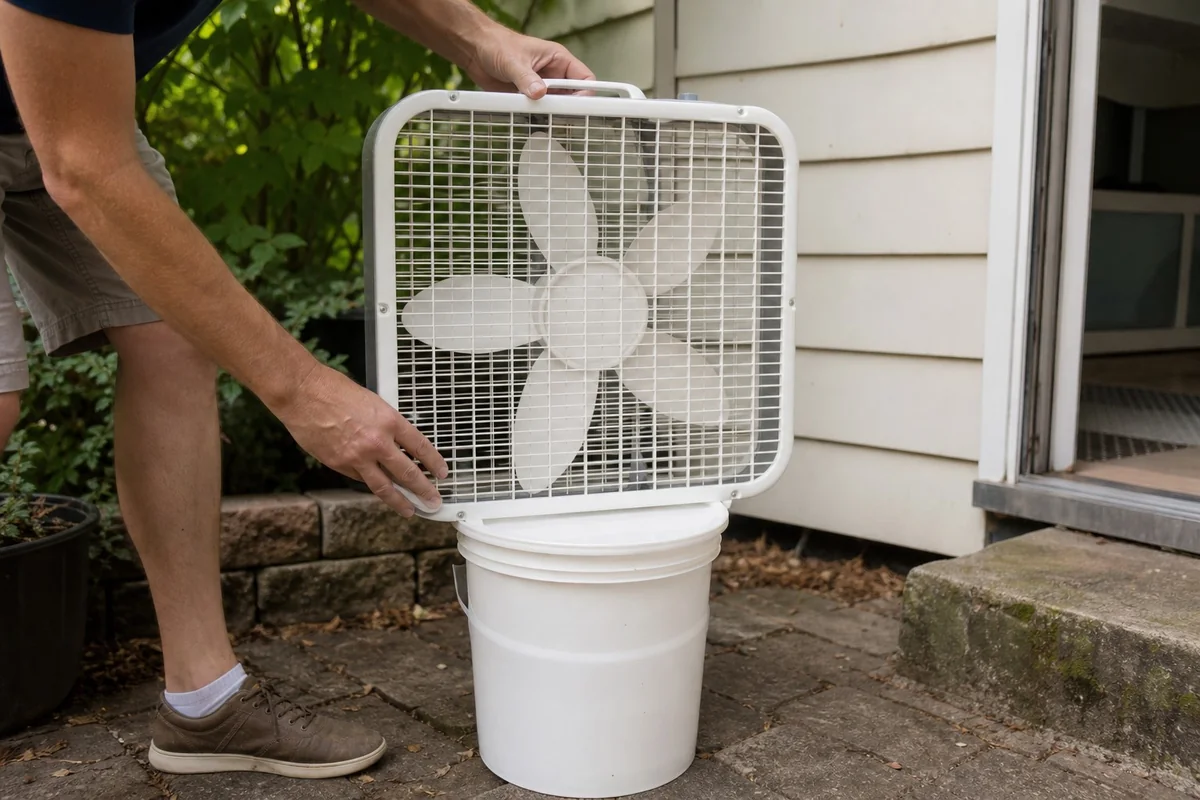

How to Make a Mosquito Trap: Box Fan, Dunk Bucket, Yeast Bottle
How to make a mosquito trap that works: a box fan with mesh, a Bti dunk bucket for egg-laying females, and what sugar, yeast and baking soda traps can really do.
The best DIY mosquito trap is a box fan with a sheet of fine mesh fastened over the back. The fan pulls mosquitoes flying near it against the mesh, where they stay stuck until they dry out and die. It runs on its own all night, uses no chemicals and catches far more than a sugar and yeast bottle. For water you cannot empty, a dark bucket of water with a piece of Bti dunk works as an egg-laying trap that kills every larva. Homemade traps thin out mosquitoes; removing standing water and wearing repellent still prevent the most bites.
Do Homemade Mosquito Traps Work?
Some do, as long as you expect a thinner crowd rather than a mosquito-free yard. Homemade traps copy the same tricks as store-bought ones: a fan that sucks mosquitoes in, carbon dioxide that imitates breath, or a pool of water where females want to lay eggs. University of California IPM's pest note on mosquitoes calls larval control the most effective approach around a home and notes that even commercial carbon dioxide traps catch only a small share of the mosquitoes they draw in. A homemade trap is a helper, not a solution.
The fan matters most. Mosquitoes are small, weak fliers, and a box fan moves enough air to pull in any that drift within a few feet of it. That is the same reason the traps used by mosquito control programs rely on a small fan to pull mosquitoes into a net. Bait makes a trap more attractive, but without a fan or a sticky surface most bait traps simply give mosquitoes something to sniff at before they leave.
Bait is where most popular recipes fall short. Sugar and yeast ferment and release carbon dioxide, and baking soda with vinegar fizzes out a quick burst of it, but both make only a trickle compared with a person breathing or with dry ice. A study in the Journal of the American Mosquito Control Association comparing carbon dioxide sources in traps found that a citric acid and baking soda generator caught more mosquitoes than an unbaited trap, but far fewer than dry ice.
What Is the Most Efficient Mosquito Trap?
Among homemade options, the fan trap catches the most for the least effort, and adding carbon dioxide beside it makes it more attractive. Among all traps, the ones that make the biggest difference over a season are the ones that stop mosquitoes from breeding, such as a dunk bucket or Bti in a rain barrel, because every larva killed is a mosquito that never bites. Efficiency here means fewer bites per evening of effort, and by that measure ten minutes spent tipping out water each week beats any trap you can build.
Our mosquito repellent and trap guides cover store-bought traps and repellents too, and the DIY mosquito traps section collects our homemade trap guides for indoors and the yard.
Homemade Mosquito Traps Compared
| Trap | How It Catches | Best For | Effort | Main Limit |
|---|---|---|---|---|
| Box fan with mesh | Suction holds mosquitoes on the screen | Patios, porches, garages | Low | Needs power; outdoor cord |
| Dunk bucket | Females lay eggs; Bti kills larvae | Shady yards | Low | Does not catch adults |
| Sugar and yeast bottle | Carbon dioxide from fermentation | Small rooms, near a fan trap | Low | Weak lure; few catches alone |
| Baking soda and vinegar | Short burst of carbon dioxide | Boosting a fan trap briefly | Low | Fizzes out quickly |
| Sticky light trap | Glue card near a small light | A dark bedroom | Low | Catches few mosquitoes |
If you only make one, make the fan trap and set a dunk bucket nearby. Together they work on adults flying through the yard and on the next generation before it can fly.
Step-by-Step: Make a Box Fan Mosquito Trap
You need a square box fan, a piece of fine mesh larger than the fan (window screen, fine tulle or a furnace filter), zip ties, bungee cords or duct tape, and an outdoor-rated extension cord if you use it outside.
- Check the airflow: turn the fan on and feel which side pulls air in; that is the intake side, usually the back.
- Cut the mesh: leave a couple of inches of overlap on every side of the fan frame.
- Cover the intake side: lay the mesh over the back of the fan so mosquitoes are pulled against it.
- Fasten it tightly: zip-tie, bungee or tape the edges so there are no gaps for mosquitoes to slip through the blades.
- Place it low and near shade: set it on the ground or a low step at the edge of the patio, near shrubs where mosquitoes rest, on a dry, stable surface.
- Add a lure if you like: a sugar and yeast bottle or a dark container of water beside the intake side makes the spot more attractive.
- Run it from dusk through the night: mosquitoes are most active in the evening, and the trap keeps working while you sleep.
- Kill the catch before switching off: leave the fan running for a few hours so trapped mosquitoes dry out, or mist the mesh with soapy water.
- Clean the mesh: turn the fan off, unplug it, then brush or rinse the screen and let it dry before the next evening.
Quick Checklist
How to make and run a box fan mosquito trap.
- Warning: Keep it away from water, children and pets.
- Warning: Plug into a GFCI outlet; bring it in before rain.
Keep electrical safety in mind. Use an outdoor-rated cord plugged into a GFCI outlet, keep the fan away from pools, birdbaths and sprinklers, and bring it inside when rain is forecast. A box fan's grill is not designed to keep small fingers out, so set it where children and pets will not reach it.
How to Make a Dunk Bucket Egg-Laying Trap
Mosquitoes that breed in containers around houses look for dark, still water with some decaying plant matter in it. A dunk bucket gives them exactly that, then kills the larvae with Bti, a bacterium sold as Mosquito Dunks and Mosquito Bits. UC IPM notes that Mosquito Dunks last about a month in water.
The idea has research behind it. In a CDC-led study of autocidal gravid ovitraps in Puerto Rico, dark buckets baited with a hay infusion and placed at most homes in a neighborhood sharply reduced Aedes aegypti numbers. One bucket in one yard will not match that, but several buckets spread around shady corners do the same job on a smaller scale.
- Container: a black or dark brown bucket of a few gallons, or any dark plastic tub.
- Bait: water plus a handful of hay, straw or grass clippings, left to steep for a few days so it smells like a natural puddle.
- Larvicide: a quarter of a Mosquito Dunk, or a sprinkle of Bti granules, floating on the surface.
- Placement: in shade under shrubs or along a fence, away from where people sit and out of reach of children and pets.
- Upkeep: top up the water after hot spells and add fresh Bti about once a month.
To set up Mosquito Dunks in other water, float a whole dunk in a rain barrel or small pond and break one into pieces for birdbaths and buckets, following the label for how much water each piece treats. Bti does not kill pupae, which do not feed, so a few adults may still emerge in the first days after treatment.
Sugar, Yeast and Baking Soda Traps
Sugar and Yeast Bottle Trap
Cut the top third off a two-liter bottle. Dissolve a quarter cup of brown sugar in a cup of hot water, let it cool until just warm, pour it into the bottom and sprinkle in a teaspoon of active dry yeast. Turn the top upside down and set it into the bottom as a funnel, tape the seam and wrap the bottle in dark paper. The yeast ferments the sugar and releases carbon dioxide for about a week.
Expect modest results on its own. The bottle gives off far less carbon dioxide than a person, and most mosquitoes that investigate never find the funnel. It works best as a lure set right beside a box fan trap, or in a small closed room where there is little competition.
Baking Soda and Vinegar
Pouring vinegar onto baking soda releases a quick fizz of carbon dioxide that is over in minutes. It can draw a few mosquitoes toward a fan trap for a short while at dusk, but it does not last through the night, and on its own it catches nothing. Commercial citric acid and baking soda generators release gas slowly over hours, which is why they worked better in the study above.
Indoor Light and Glue Traps
A small night light behind a sticky card or a shallow dish of soapy water catches gnats and the occasional mosquito in a dark bedroom. Many mosquitoes that bite people are not strongly drawn to light, so this is a minor helper; screens and a fan by the bed do more.
Where to Put Homemade Traps and What to Expect
Mosquitoes rest by day in dense shrubs, ivy, tall grass, under decks and in garages, and come out at dusk. Put fan traps and dunk buckets near those spots, between the resting areas and the places you use, never right beside the table. Indoors, set a trap low in the room where you are bitten, with doors and windows closed.
Judge a trap by bites, not by the number of dead mosquitoes. Count bites on a few evenings before you start and again after a couple of weeks of running the traps every night. If bites drop, keep going; if not, look for the breeding water feeding the yard, because traps cannot keep up with a steady supply.
Pair traps with the basics. Empty, scrub or cover anything that holds water once a week, keep window screens in good repair and wear an EPA-registered repellent when you are outside at dusk. A homemade trap adds a little on top of those steps.
Common Mistakes With Homemade Traps
- Putting the trap beside the table: any lure draws mosquitoes toward people sitting next to it.
- Leaving gaps in the mesh: mosquitoes pulled into a gap pass through the blades and fly out the front.
- Running the fan only when guests arrive: mosquitoes already resting in the yard are the ones you want to catch.
- Letting a yeast bottle or bucket go stale: a dried-out or moldy lure stops attracting anything.
- Using a light bucket: pale containers in full sun attract far fewer egg-laying females than dark ones in shade.
- Forgetting the larvicide: a bucket of water without Bti becomes a mosquito nursery within a week in summer.
Homemade Traps for No-See-Ums
No-see-ums, or biting midges, are tiny enough to pass through ordinary window screen, so a box fan trap needs a finer cover to hold them: a furnace filter, fine tulle or several layers of mesh. They breed in damp soil, mud and the edges of ponds and marshes rather than in buckets, so a dunk bucket does little against them. A fan blowing across a porch is often the most useful homemade defense, since midges are even weaker fliers than mosquitoes.
Common Questions About DIY Mosquito Traps
Does a vinegar mosquito trap work?
Does a vinegar mosquito trap work?
Not by itself. Vinegar draws fruit flies, not mosquitoes; mixed with baking soda it gives off a short fizz of carbon dioxide that is gone in minutes. Use a fan trap for mosquitoes and save vinegar traps for fruit flies.
How long does a sugar and yeast mosquito trap last?
How long does a sugar and yeast mosquito trap last?
About a week, until the yeast uses up the sugar and stops producing gas. Pour it out, rinse the bottle and mix a fresh batch, and keep it beside a fan trap for the best results.
What kind of mesh works best on a box fan trap?
What kind of mesh works best on a box fan trap?
Fine window screen holds mosquitoes well; a furnace filter or fine tulle also catches smaller insects such as midges. Avoid mesh so tight that it blocks the airflow, which weakens the suction.
Can I use dry ice with a homemade fan trap?
Can I use dry ice with a homemade fan trap?
Yes, dry ice is the strongest carbon dioxide source available to homeowners. Keep it in a vented cooler near the fan intake, handle it only with thick gloves and never store it in a sealed container or a closed room.
Will a homemade trap work indoors?
Will a homemade trap work indoors?
A small fan with mesh or a sticky light trap catches strays in a closed room, but indoors the best fixes are screens, closed doors at dusk and a fan by the bed.
Key Takeaways
- A box fan with fine mesh over the intake side is the most effective homemade mosquito trap.
- A dark dunk bucket with hay-steeped water and Bti kills the next generation; refresh the Bti about monthly.
- Sugar and yeast or baking soda and vinegar produce little carbon dioxide; use them only as a lure beside a fan trap.
- Place traps near shady resting spots and away from where people sit, and run them every night.
- Use outdoor cords, GFCI outlets and keep fans away from water, children and pets.
- Removing standing water and wearing repellent prevent more bites than any trap.