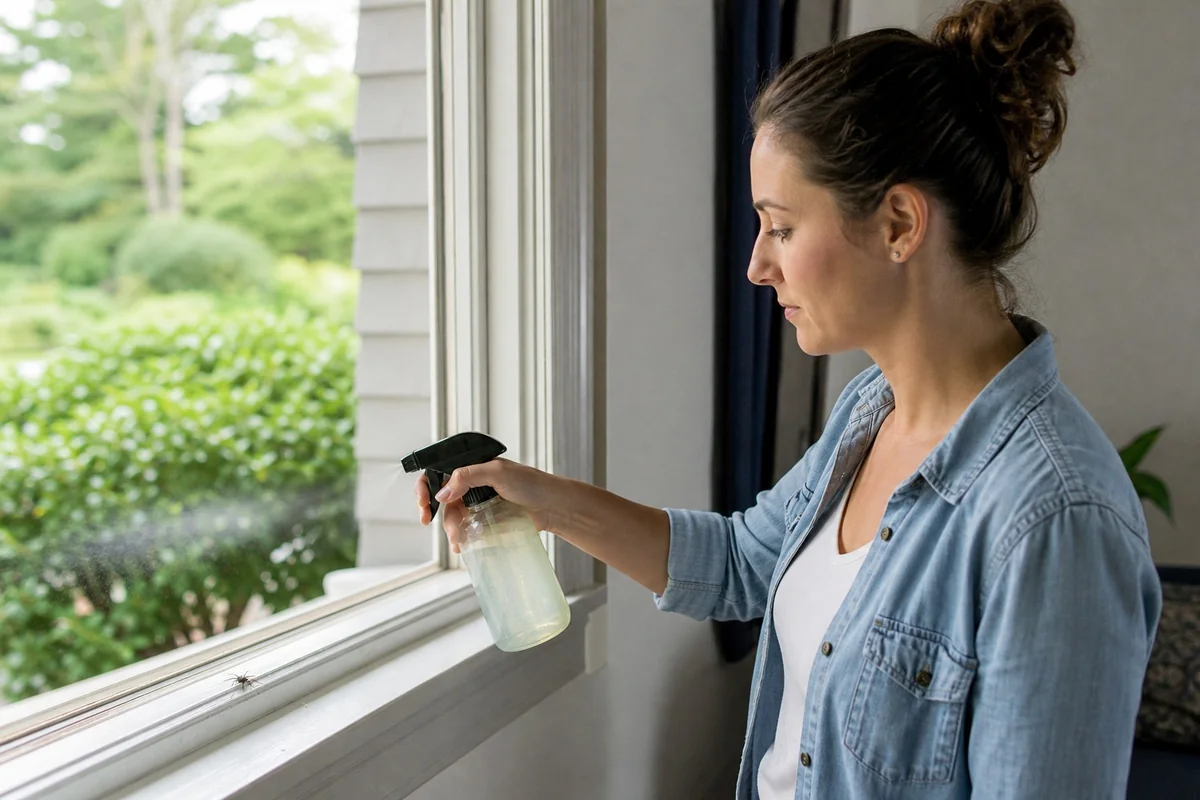

Homemade Indoor Spider Repellents: What Works and How to Spray
Homemade indoor spider repellents: what the evidence says about peppermint, vinegar, lemon and lavender, plus a peppermint spray recipe.
A homemade spider repellent is a spray or scent you make from kitchen ingredients, usually peppermint oil and water, to discourage spiders from settling indoors. Peppermint oil is the only one with some lab evidence, and only for some species. A soapy water spray kills spiders it soaks, while vinegar, lemon and lavender have no good evidence behind them.
What Homemade Spider Repellents Can and Cannot Do
Homemade sprays work on spiders in two different ways. A scent such as peppermint oil may make a spot less attractive to a spider looking for somewhere to build a web. A soapy spray works by contact: it can kill a spider you soak with it, but leaves nothing behind once it dries.
Neither drives out spiders already settled in their webs, and neither stops new ones coming in through gaps under doors and around windows. That is the honest limit of any home remedy, and it is why the spray works best as an add-on to sealing and vacuuming rather than the whole plan. For store-bought options that last longer, see our guide to the best spider repellents for the house; the indoor spider repellent guides cover garages, cars and pet-safe choices.
What the Evidence Says About Peppermint and Other Scents
Very few home remedies for spiders have been tested at all. The best-known test is a lab study in the Journal of Economic Entomology that compared three of the most recommended remedies: peppermint oil, lemon oil and chestnuts. Spiders were given a choice between a treated path and a plain one.
Peppermint oil and chestnuts repelled two of the three species tested. The third species, a common house-dwelling false widow, ignored them both, and lemon oil repelled none of the three. The researchers also pointed out that a spider already settled in a web may not leave, so even a scent that works mostly stops spiders from moving in.
That makes peppermint the most reasonable homemade choice, with modest expectations. Lavender, eucalyptus, tea tree, cinnamon, citrus peel and cedar are often recommended online, but we found no published tests showing they keep spiders away.
Homemade Spider Repellents Compared
The table sorts the most common home remedies by how well they are supported and what they are good for. “Some” evidence means a lab test found an effect on some spider species; “contact only” means the remedy kills what it soaks and nothing more. Remedies with no published test are not proven useless, but there is no reason to expect them to beat peppermint, and several can stain floors or harm pets.
| Method | Evidence | Why | Use For |
|---|---|---|---|
| Peppermint oil spray | Some | Repelled two of three species in lab tests | Thresholds, sills, corners |
| Chestnuts (conkers) | Some | Same lab result as peppermint | Not around children or dogs |
| Soapy water spray | Contact only | Kills spiders it soaks, no residue | Spiders you can see |
| Vacuuming | Works | Removes spiders, webs and egg sacs | Corners, ceilings, closets |
| Lemon or citrus | No effect | Lemon oil repelled none in lab tests | Not recommended |
| Vinegar | No reliable evidence | No tests show it repels spiders | Cleaning only |
| Lavender, eucalyptus, cinnamon | No reliable evidence | No published tests found | Not recommended |
Only a few rows earn a place in a real plan: peppermint for deterring some spiders, and soapy water or a vacuum for the ones you can see. Everything else on the list mostly makes the house smell different while the spiders stay where they are.
How to Make a Peppermint Oil Spider Spray
There is no tested dose for spiders, so this is a common household mix rather than a proven formula.
- 16-ounce spray bottle filled almost to the top with water.
- About 1 teaspoon of peppermint essential oil.
- A few drops of liquid dish soap, which helps the oil mix into the water instead of floating on top.
Shake before every use, since the oil separates. Spray along door thresholds, window sills, baseboards behind furniture and the corners of closets and basements, where spiders settle. Reapply every few days at first, then weekly, because the scent fades as it dries. Test on a hidden spot first, since oils can mark fabric, unsealed wood and some painted finishes.
Keep cats in mind. Peppermint and many other essential oils are toxic to cats, so do not spray where a cat sleeps, eats or grooms, and keep the bottle away from pets and children.
How to Spray Spiders You Can See
For a spider on the wall or ceiling, a soapy water spray is the simplest homemade option. Mix about 4 teaspoons of liquid dish soap into a quart of water, the strength extension gardening guides use for soap sprays on insects, and soak the spider directly. Soap acts only on contact, so a light mist or a spray on an empty web does nothing.
A vacuum is faster and less messy. University of California IPM notes that vacuuming is an effective way to remove spiders, along with their webs and egg sacs, and it reaches high corners without wetting walls. Empty the canister or bag outdoors afterward.
What Works Better Than Any Homemade Spray
Spiders stay where there are insects to eat and quiet places to build. Cutting those off does more than any scent:
- Seal entry gaps: door sweeps, weatherstripping, caulk around pipes and window frames, and screens without tears.
- Move outdoor lights: lights by doors draw insects, and insects draw spiders.
- Vacuum regularly: corners, behind furniture, under beds and in closets, including webs and egg sacs.
- Cut clutter: store items in closed plastic bins rather than cardboard boxes on the floor.
- Use sticky traps: flat glue boards along baseboards catch wandering spiders and show where they come in.
Many people notice more spiders in late summer and fall, when males wander in search of mates. That is the time to start: seal gaps and set traps before then, and use the peppermint spray on thresholds as a backup.
Common Questions About Homemade Spider Repellents
Does vinegar kill spiders?
Does vinegar kill spiders?
Undiluted vinegar may kill a small spider that is soaked in it, but there is no good evidence that it repels spiders or controls them in a house. Its smell fades quickly, and acidic vinegar can etch marble, granite and some finishes, so it is better kept for cleaning.
Do spiders hate lavender?
Do spiders hate lavender?
There is no published test showing lavender repels spiders. It is a common ingredient in natural sprays because people like the scent, but the only scent with lab evidence is peppermint, and even that deterred some species and not others.
When should you start spraying for spiders?
When should you start spraying for spiders?
Before late summer, when many people start seeing more spiders as males wander in search of mates. Seal gaps and set sticky traps first, then spray thresholds and sills, and keep reapplying a homemade spray every week or so through fall.
Can I use horse chestnuts to keep spiders away?
Can I use horse chestnuts to keep spiders away?
Chestnuts repelled two of three species in the same lab study as peppermint, so placing a few on window sills is harmless to try. Horse chestnuts are poisonous if eaten, so keep them away from children and dogs.
Key Takeaways
Peppermint oil is the only homemade spider repellent with lab evidence, and it deterred some species but not others. Lemon oil did nothing in the same tests, and vinegar, lavender and cinnamon have no published tests showing they work.
Use a soapy water spray or a vacuum for spiders you can see, a peppermint spray on thresholds and sills, and keep it away from cats. Lasting results come from sealing gaps, moving outdoor lights and cutting clutter, so the spray is only the finishing touch.
Today, walk the house and check the bottom of every exterior door for a gap you can see light through.
Related Articles
Best Spider Repellents for the Garage: Sprays, Traps and Seals
The best spider repellents for the garage: Miss Muffet's Revenge barrier spray, Raid MAX for black widows, Catchmaster traps, a door threshold seal and Mighty Mint.

Best Spider Killer Sprays for Indoors: Residual and Contact Picks
The best spider killer sprays for indoors: Ortho Home Defense MAX, Miss Muffet's Revenge, odorless Harris, Raid MAX for black widows and TERRO's aerosol.
Best Spider Repellents for the House: Sprays, Peppermint, Traps
The best spider repellent sprays for the house: Miss Muffet's Revenge barrier, Raid MAX and TERRO aerosols, peppermint sprays, Catchmaster traps and sealing tips.
Best Pet-Safe Spider Repellents: Options for Dog and Cat Homes
Best pet-safe spider repellents for indoors: Vanquar and Waspika peppermint sprays for dog homes, glue boards for cat homes, and why essential oils and cats clash.