
Does the Mosquito Magnet Work? How It Works and Why Results Vary
Does the Mosquito Magnet work? How propane CO2 traps lure mosquitoes, why they catch only a share, what affects results and how they compare with other options.
The Mosquito Magnet works as a trap, but it rarely clears a yard on its own. It burns propane to produce carbon dioxide, warmth and moisture, adds a scent lure, and uses a fan to pull mosquitoes that come close into a net. University of California IPM notes that carbon dioxide traps like it capture only a small share of the mosquitoes they attract, and that a yard may need two or more. It does best when it runs all season, sits in the right spot and is paired with removing standing water.
Does the Mosquito Magnet Work? The Short Answer
It can catch mosquitoes in large numbers. Whether it cuts the bites you get is a different question. University of California IPM's pest note on mosquitoes says that carbon dioxide traps such as the Mosquito Magnet attract host-seeking mosquitoes but capture only a small proportion of them, and that two or more traps per yard may be needed. The same note points out that some mosquitoes fly several miles from where they develop.
Put together, that explains why results differ so much from one yard to the next. On a property where most mosquitoes breed nearby and the trap runs from early spring, the catch can make a noticeable difference. On a lot next to a marsh, a wooded creek or a neighbor's neglected pool, the trap is emptying a bucket that keeps refilling, and bites continue.
If you are weighing a Magnet against cheaper machines, our roundup of the best mosquito traps puts fan, egg-laying and plug-in models side by side, and every trap guide we publish sits in the mosquito traps section.
How a Mosquito Magnet Works
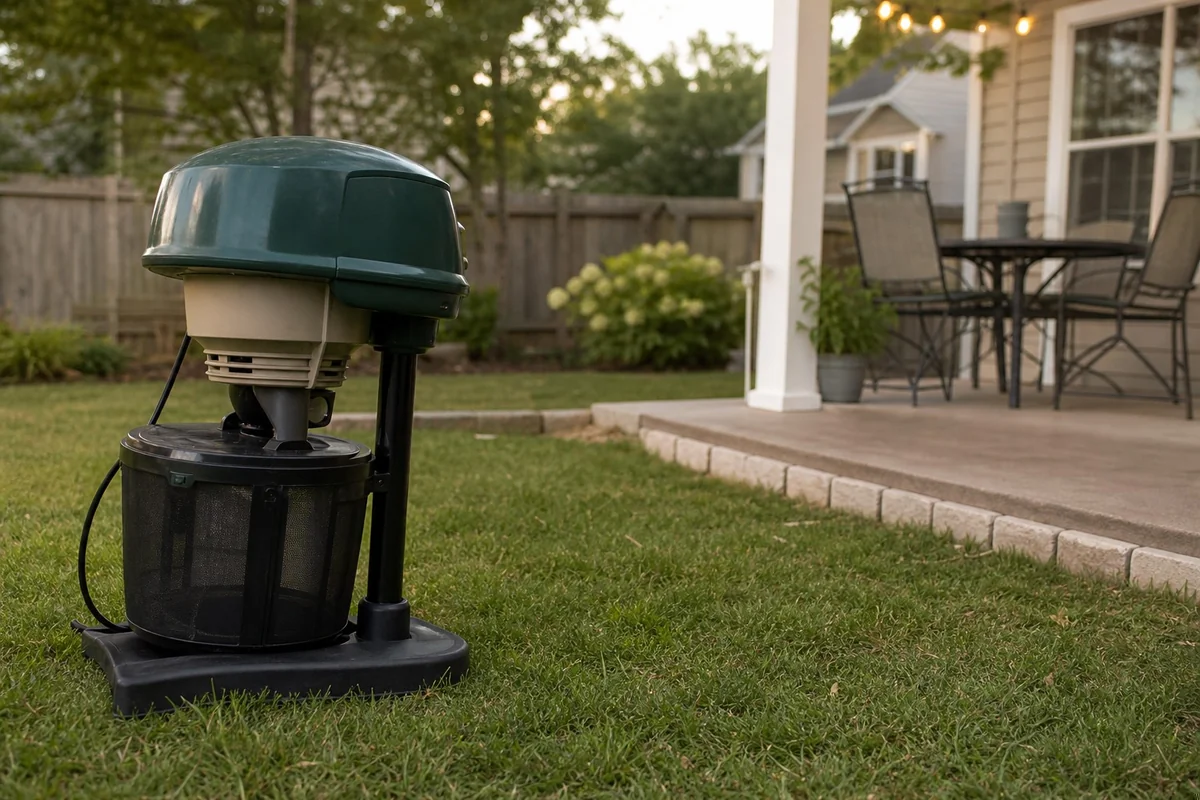
Female mosquitoes find a blood meal by following carbon dioxide from breath, then body heat, moisture and skin odor at close range. A Mosquito Magnet imitates that chain. It burns propane from a standard grill tank inside a small combustion chamber, turning it into a steady plume of carbon dioxide with some heat and water vapor. A cartridge of attractant, often octenol or a blend meant to mimic skin, adds the scent.
A fan pushes that plume outward and, at the same time, pulls air back in through an intake around it. Mosquitoes that follow the plume to its source get sucked into a mesh net, where they dry out and die. No poison is used, and the trap does not rely on light, which is why it catches more mosquitoes and fewer moths than a UV trap.
Because it attracts mosquitoes from across a yard, placement matters. A trap set downwind of the breeding and resting areas, in shade and away from where people sit, draws mosquitoes toward itself. One set beside the patio competes with the people there and may pull mosquitoes toward them as much as toward the net.
Why the Trap Needs Weeks, Not Hours
A carbon dioxide trap works by removing egg-laying females before they can produce the next generation. That is slow by design. Each female it catches is one fewer laying eggs in the gutter or birdbath, but the mosquitoes already in the yard, and the larvae already in the water, keep coming for a while. Switching the trap on for a party and judging it the next morning tells you almost nothing.
Why Results Vary From Yard to Yard
- The local species: species differ in how strongly they respond to carbon dioxide and to each lure, which is why trap makers sell more than one attractant; a lure that works on night-biting mosquitoes may do less for day-biters such as the Asian tiger mosquito.
- Where mosquitoes come from: water on your own property can be treated; a nearby wetland or ditch keeps supplying new adults.
- Placement: traps in sun, wind or right beside people catch less than traps in shade near resting areas.
- Running time: gaps for empty propane tanks or spent lures let mosquito numbers climb back.
- Maintenance: a clogged nozzle, a full net or a dirty fan reduces the plume and the catch.
Running costs are part of the answer to “is it worth it”. A carbon dioxide trap uses a propane tank every few weeks, needs fresh attractant on a schedule and has parts such as nozzles and nets that wear out. A trap that runs without gaps all season has a far better chance of making a difference than one left idle for weeks between tanks.
Mosquito Magnet vs Other Options
| Option | How It Works | Best For | Main Limit |
|---|---|---|---|
| Propane CO2 trap (Mosquito Magnet) | Carbon dioxide, heat and lure; fan and net | Large yards with a budget | Small share caught; fuel and lure costs |
| Lure trap without propane (such as Biogents) | Skin-scent lure, optional CO2; fan and net | Day-biting container mosquitoes | Needs power; smaller reach |
| UV fan trap | Light and fan | General flying insects | Catches many moths |
| Egg-laying trap | Water attracts females to lay eggs | Container breeders near homes | Works best across many homes |
| Area repeller | Releases repellent around a table | Protecting a seated group | Weak in wind; refills |
| Bti larvicide | Kills larvae in water | Ponds, barrels, birdbaths | Does not affect adults |
The best Mosquito Magnet alternative depends on what is biting. If day-biting mosquitoes come from containers around the house, a lure trap built for them, egg-laying traps and a weekly cleanup usually do more. If bites happen at the dinner table, an area repeller protects people right away. And wherever there is water you cannot drain, larvicide stops mosquitoes before any trap has to catch them.
When comparing the Mosquito Magnet with Biogents traps, the key difference is the attractant. The Magnet leans on a large carbon dioxide plume from propane, which reaches farther. Biogents traps lean on a scent that imitates human skin, with carbon dioxide as an add-on, and target the container-breeding mosquitoes common in suburban yards. Neither replaces removing standing water.
Common Questions About the Mosquito Magnet
Where do mosquitoes go after they bite you?
Where do mosquitoes go after they bite you?
A fed female flies to a sheltered, shady spot such as dense shrubs, tall grass or a garage to rest while she digests the blood. A few days later she looks for standing water to lay eggs, which is why removing water near the house breaks the cycle.
How do mosquito coils repel mosquitoes?
How do mosquito coils repel mosquitoes?
A coil smolders slowly and releases a pyrethroid such as allethrin into the smoke, which repels or knocks down mosquitoes close by. UC IPM notes that coils work best with little air movement, and they are for outdoor use only.
Is killing mosquitoes bad for the environment?
Is killing mosquitoes bad for the environment?
Removing the mosquitoes around your own home has little effect on wildlife, since fish, frogs and insects have many other foods. The bigger risk comes from broad insecticide sprays and zappers, which kill beneficial insects, so traps and larvicides that target mosquitoes are the gentler choice.
Can a Mosquito Magnet run without a propane tank?
Can a Mosquito Magnet run without a propane tank?
Propane-powered models need a tank to make carbon dioxide; without it they produce no plume and catch little. Lure-based traps from other makers use electricity and scent instead, sometimes with carbon dioxide from a separate cylinder.
Does a Mosquito Magnet catch other insects?
Does a Mosquito Magnet catch other insects?
It catches mostly biting insects that follow carbon dioxide, such as mosquitoes and biting midges, and far fewer moths and beetles than a light trap or zapper, because it does not use a bright light.
Key Takeaways
- The Mosquito Magnet uses propane-generated carbon dioxide, heat, moisture and a lure to pull mosquitoes into a net.
- It catches many mosquitoes but only a small share of those it attracts, and a yard may need more than one trap.
- It works slowly, over weeks, by removing egg-laying females; start it early in the season and keep it running.
- Place it in shade near resting and breeding areas, away from people.
- Budget for propane, attractant and parts, and remove or treat standing water, which matters more than any trap.
- If bites happen at the table, add an area repeller or skin repellent; if a wetland is nearby, expect limited results.
Related Articles
Best Mosquito Traps for the Patio and Garage: What Actually Helps
The best mosquito traps for the patio and garage: DynaTrap at the yard's edge, a Thermacell repeller for the table, a garage zapper and a Bti dunk bucket.

Best Mosquito Traps: UV Fan, Indoor and Egg-Laying Picks
The best mosquito traps: DynaTrap's quiet UV fan traps for yards, a TIENBE plug-in for indoors and egg-laying traps, plus what traps can and cannot do.

Best Home Mosquito Killer Machines: Zappers, Traps and More
The best mosquito killer machines for the home: Flyghost and ASPECTEK zappers for indoors, a DynaTrap for the yard, Raid fogger for parties and Bti dunks.

Best Mosquito and Tick Skin Repellents: Picaridin, DEET and OLE
The best mosquito and tick repellents for skin: Sawyer picaridin lotion, OFF! Deep Woods, Repel 40% DEET and Murphy's OLE, plus how to stop ticks on the trail.