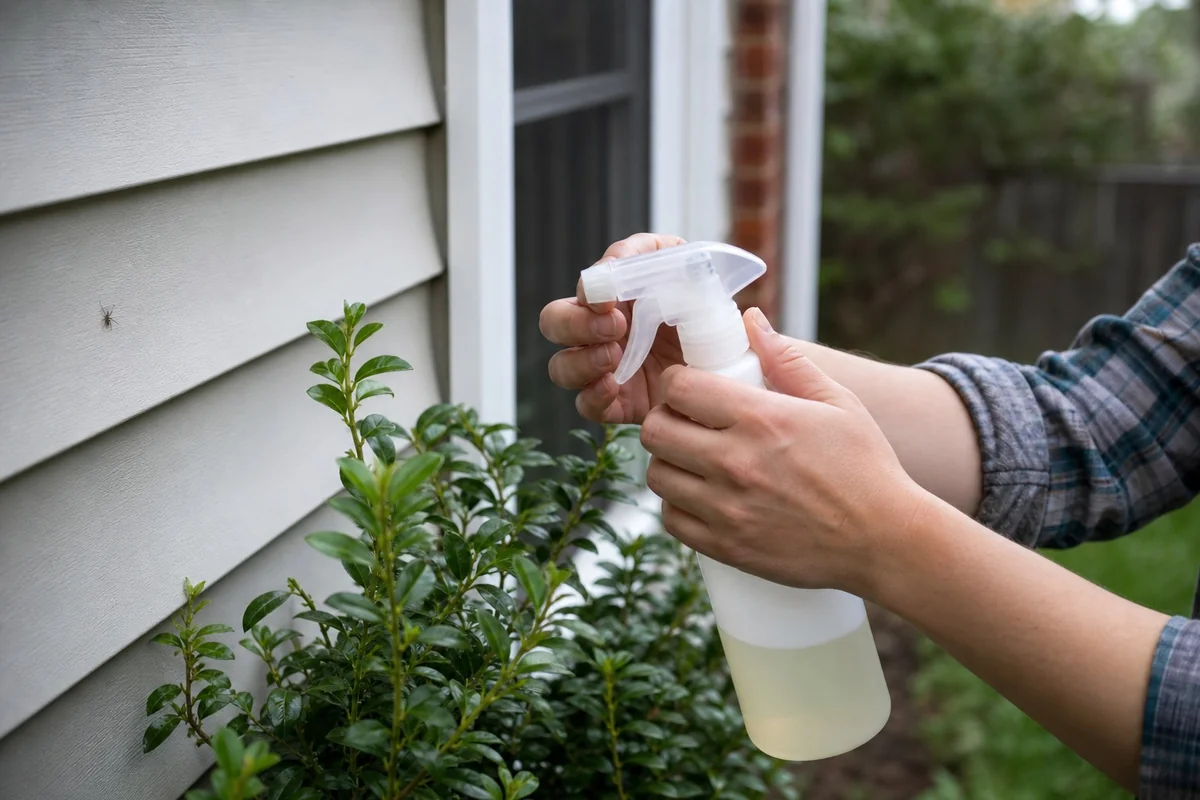

Homemade Outdoor Spider Repellents: A Weekly Routine That Works
Homemade outdoor spider repellents: knock down webs, switch to amber bulbs, clear the walls, then use a peppermint mix. What vinegar, soap and baking soda really do.
To keep spiders off the outside of the house without insecticides, hose or brush down webs every week, switch entry lights to warm or amber bulbs, clear clutter and plants from the walls, then wipe or spray a peppermint oil mix on door and window frames, reapplying after rain. Scents alone do little; removing webs and the insects spiders eat does most of the work.
What You Need
- A garden hose with a jet nozzle or a long-handled cobweb brush: to knock down webs and egg sacs.
- Warm-white or amber LED bulbs: for porch, entry and garage lights.
- A 16-ounce spray bottle and a cloth: for the peppermint mix.
- Peppermint essential oil and liquid dish soap: about a teaspoon of oil per bottle plus a few drops of soap.
- Gloves: for clearing woodpiles and corners where black widows hide.
- Caulk and door sweeps: for gaps that let spiders inside.
The cost is low, and most of the work is a one-time afternoon followed by a weekly ten-minute sweep. No step needs special skill, but a ladder is safer than leaning a pole at full stretch for second-story eaves.
Why Homemade Repellents Work Best as Part of a Routine
Spiders build on the outside of a house because insects gather there, mostly around lights and sheltered corners. University of California IPM's pest note on spiders recommends removing webs with a broom or a strong spray from a hose, moving outdoor lights away from doors and windows, and clearing debris near the foundation. It also notes that insecticides will not give long-term control outdoors, so a homemade plan is not a step down from spraying; it is the same approach UC IPM puts first.
Scents are the weakest part of that plan. In lab tests, peppermint oil deterred some spider species and not others, and lemon oil deterred none; outdoors, sun, wind and rain fade any oil within days. Use the peppermint mix as a finishing touch on frames and thresholds, not as the main defense.
For store-bought sprays, dusters and bulbs, see our guide to the best outdoor spider repellents. The outdoor spider spray guides also compare insecticides for heavier problems.
How to Keep Spiders Away Outside Without Insecticides
- Knock down every web: hose or brush the eaves, soffits, window corners, light fixtures, railings and porch ceilings, including the small round or papery egg sacs tucked into corners.
- Change the bulbs by the doors: replace bright white bulbs with warm-white or amber LEDs, which draw fewer flying insects to the spot where spiders build.
- Move lights off the house where you can: a fixture on a post shining toward the door draws insects away from the walls.
- Clear the foundation: move firewood, stacked pots, leaf piles and stored items away from the walls, and trim shrubs so they do not touch the house.
- Seal the gaps: add door sweeps and caulk gaps around windows, pipes and vents so outdoor spiders do not wander inside.
- Mix the peppermint spray: add about a teaspoon of peppermint oil and a few drops of dish soap to a 16-ounce bottle of water and shake well.
- Apply to frames and thresholds: spray or wipe the mix on door frames, window frames, thresholds and railings where you have cleared webs.
- Repeat weekly and after rain: sweep new webs and reapply the mix, since rain and sun remove it within days.
Quick Checklist
How to keep spiders off the outside of the house without insecticides.
- Warning: Wear gloves near woodpiles and dark corners where black widows hide.
- Warning: Keep peppermint mixes away from cats.
Expect webs to keep appearing for a while, since spiders already living nearby and eggs you missed will rebuild. If they come back as fast as ever after several weeks, the light and clutter steps usually need another look before anything else.
Homemade Sprays: What Works and What Does Not
- Peppermint oil spray: the only homemade scent with lab evidence, and only for some species; reapply weekly and after rain.
- Soapy water: about 4 teaspoons of dish soap in a quart of water kills spiders it soaks on contact, but leaves nothing behind once dry; spray the spider, not the wall.
- Vinegar: no good evidence that it repels spiders, and household vinegar can damage plants and etch stone, so keep it off flower beds, pavers and marble.
- Dawn and vinegar mixes: the soap does the killing on contact; the vinegar adds little except the risk to plants.
- Baking soda: no evidence it repels or kills spiders.
- Chestnuts: in the same lab tests as peppermint, they deterred some species; a few on window sills are harmless to try, but keep horse chestnuts away from dogs and children.
- Citrus peels and lemon oil: lemon oil repelled no species in lab tests.
Test any spray on a hidden patch of painted trim or stained wood first, since essential oils can mark some finishes. Keep peppermint mixes away from cats, which are sensitive to many essential oils.
Common Mistakes and Fixes
- Spraying over thick webs: the mix lands on silk, not the frame; sweep first, then spray.
- Leaving bright white porch lights on all night: insects gather and spiders follow; switch to amber bulbs or a motion sensor.
- Spraying once and stopping: outdoor oils fade in days; reapply weekly and after rain.
- Using vinegar near plants: it can scorch leaves; keep it off beds and lawns.
- Ignoring the woodpile: black widows hide there; move it away from the house and wear gloves.
Most homemade plans fail because they rely on the spray and skip the lights and clutter. Fix those first and the spray has much less to do.
When to Use Something Stronger
A homemade routine handles the common web builders on most houses. It is not enough when black widows keep turning up around decks, woodpiles or sheds, when wolf spiders keep coming inside despite sealed doors, or when a large house makes weekly sweeping impractical.
In those cases, a residual insecticide applied along the foundation, frames and eaves, or a contact spray that lists black widows, is the next step. Keep sweeping webs and using warm bulbs alongside it, since those steps still do most of the work, and apply any insecticide only to the house surfaces, away from flowers, vegetable beds and water.
Common Questions About Homemade Outdoor Spider Repellents
What can I put outside to keep spiders away?
What can I put outside to keep spiders away?
Warm-white or amber bulbs by the doors, clear space between the walls and plants or stored items, door sweeps and caulk, and a weekly web sweep do the most. A peppermint mix on frames and thresholds can help with some species but fades within days outdoors.
Can I spray the peppermint mix on plants next to the house?
Can I spray the peppermint mix on plants next to the house?
It is better not to. Essential oils can scorch leaves, especially in hot sun, and spiders on shrubs are mostly harmless. Trim plants back from the walls instead, and if you do spray near them, test a few leaves first and spray in the evening.
Will a homemade spray keep black widows away?
Will a homemade spray keep black widows away?
No homemade spray has been shown to repel black widows. Clear woodpiles and clutter, wear gloves when moving stored items, and use a contact spray that lists black widows on the ones you find.
Does baking soda keep spiders away?
Does baking soda keep spiders away?
There is no evidence that it does. Sprinkling it around the foundation or on window sills mostly leaves a residue to wash off; sweeping webs and changing outdoor bulbs work far better.
Key Takeaways
The homemade outdoor routine that works is mostly mechanical: knock down webs and egg sacs weekly, switch entry lights to warm or amber bulbs, clear the foundation and seal gaps. A peppermint mix on frames and thresholds can help with some species, but it fades fast and needs reapplying after rain.
Soapy water kills spiders it soaks, while vinegar, baking soda and citrus have no good evidence behind them. If black widows or persistent wolf spiders remain, add a labeled insecticide to the routine.
This evening, turn on the porch light after dark and note which corners have the most webs, then start there.
Related Articles
Best Outdoor Spider Sprays: Residual, Contact, Plant-Based Picks
Best outdoor spider sprays: Miss Muffet's Revenge for eaves and siding, TERRO T2302 on a budget, Black Flag for black widows and STEM plant-based spray for spot use.
Best Outdoor Spider Insecticides: Bifenthrin, Granules, Aerosols
Best insecticides for spiders outdoors: Talstar One bifenthrin concentrate, Miss Muffet's Revenge, Amdro granules for wolf spiders and Black Flag for black widows.
Best Outdoor Spider Repellents: Sprays, Concentrates, Bug Lights
Best outdoor spider repellents: Miss Muffet's Revenge, Talstar One concentrate, Black Flag and Raid MAX for black widows, a cobweb duster and amber bug-light bulbs.
Homemade Indoor Spider Repellents: What Works and How to Spray
Homemade indoor spider repellents: what the evidence says about peppermint, vinegar, lemon and lavender, plus a peppermint spray recipe.