
How to Make Homemade Wasp Spray, and When Not to Use It
How to make homemade wasp spray with dish soap and water, how to use it safely at night, homemade yellowjacket traps and repellents, and when to call a professional.
The best homemade wasp spray is plain dish soap mixed into water, sprayed from a bottle or pump sprayer set to a stream. The soap coats a wasp's body and blocks the pores it breathes through, killing it within seconds of being soaked. It works only on wasps it hits directly, so use it on small, exposed paper wasp nests at night, wearing full protective clothing. For yellowjacket nests in the ground or inside walls, large hornet nests or anyone with a sting allergy, a commercial jet spray or a professional is the safer choice.
What You Need
- For the spray: liquid dish soap, water and a spray bottle with an adjustable nozzle, or a garden pump sprayer that can shoot a stream.
- For protection: long sleeves, long pants tucked into socks, gloves, a hat and a veil or safety glasses, plus a flashlight covered with red film.
- For removal: a long stick or broom and a trash bag.
- For a yellowjacket trap: a two-liter bottle, scissors, tape, sugar water or a scrap of meat, and a drop of soap.
Everything except the veil is likely already in the house. A cheap mesh beekeeping veil is worth buying if you plan to deal with nests yourself.
Does Homemade Wasp Spray Work?
Soap and water does kill wasps, with an important catch. University of California Cooperative Extension's guide to soap sprays as insecticides explains that soap works only when it soaks the insect; it has no lasting residue and does nothing to insects that are not hit. On a wasp, a good soaking clogs the openings it breathes through and it dies quickly. A wasp that is only misted will fly off, often angry.
That makes homemade spray best for small nests you can soak thoroughly at close-to-medium range, such as a paper wasp nest under a railing or eave that is no bigger than your hand. University of California IPM's pest note on yellowjackets and other social wasps notes that paper wasp colonies are small, while yellowjacket colonies in the ground or in walls can be many times larger, and that hiring a professional is the easiest and safest way to eliminate those nests.
Our flying insect guides compare commercial wasp sprays too, and the homemade wasp killer section covers powders and DIY methods for nests.
Step-by-Step: Make and Use Soap and Water Wasp Spray
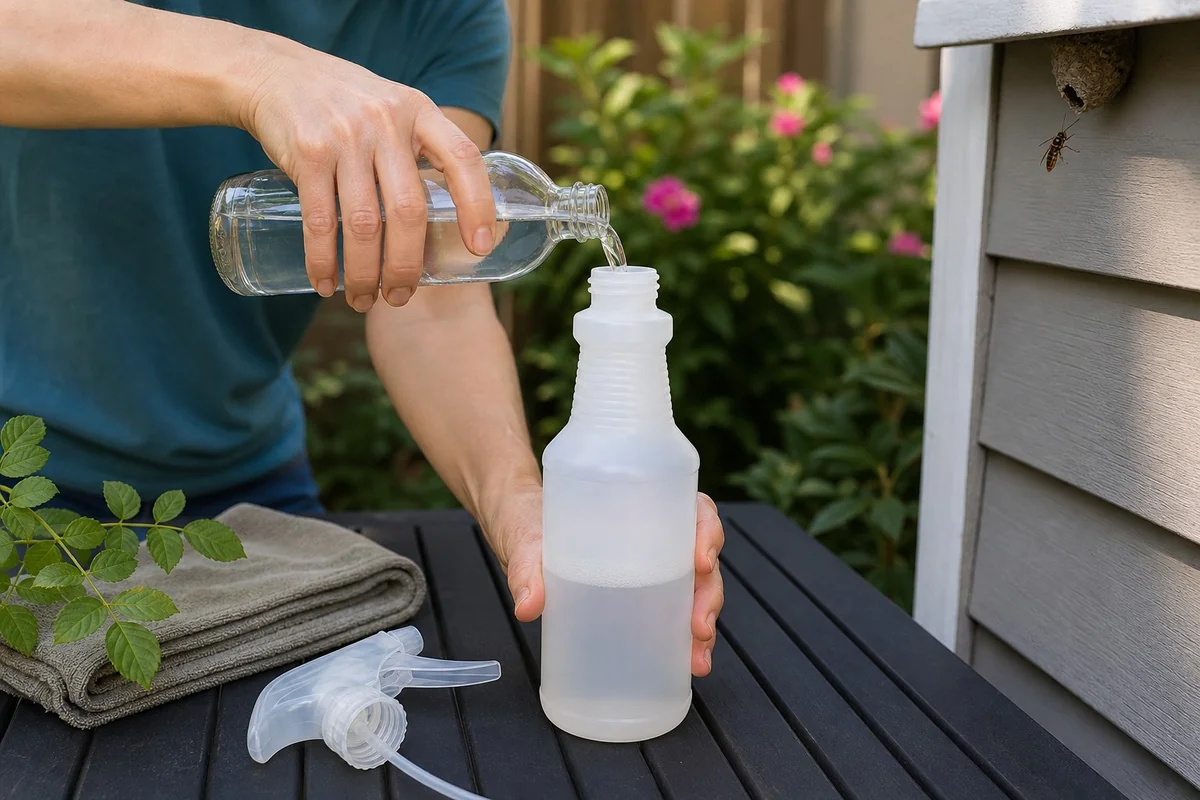
- Mix the spray: add about two tablespoons of liquid dish soap to a quart of water, or a few ounces per gallon in a pump sprayer, and swirl gently so it does not foam.
- Set the nozzle to a stream: a jet reaches farther and soaks the nest; a mist drifts and only irritates wasps.
- Scout the nest in daylight: from a distance, note its size, the wasp type and your escape route.
- Wait until dark: wasps settle on the nest at night and are slower in the cool air.
- Dress for it: cover your whole body, including gloves and a veil, and use a red-filtered light that wasps see poorly.
- Spray from as far as the stream reaches: soak the nest completely, including the open cells underneath, for several seconds.
- Walk away: calmly along your planned route, and keep children and pets inside.
- Check the next day: from a distance; if wasps are still active, repeat that night.
- Remove the nest: once it is quiet, knock it into a trash bag with a long stick and seal the bag.
Quick Checklist
How to make and use a soap and water wasp spray.
- Warning: Anyone allergic to stings should not do this.
Some recipes add vinegar, salt or peppermint oil. Vinegar and salt add little to the killing power, and essential oils mainly change the smell. Soap is the active ingredient; the rest is optional. Keep the spray off plants you value, since strong soap solutions can scorch leaves.
Other Homemade Wasp Killers and Repellents
Homemade Yellowjacket Trap
A bottle trap catches yellowjackets foraging around a patio. Cut the top third off a two-liter bottle, pour a few inches of water with a drop of soap into the base, add bait, and invert the top into the base as a funnel. In spring and early summer, yellowjackets hunt protein, so a scrap of meat or fish works best; in late summer they switch to sweets, and sugar water or juice draws them in. UC IPM advises placing traps between the area you want to protect and where wasps nest, and away from where people gather.
Peppermint Oil Repellent Spray
A few drops of peppermint oil with a little soap in a bottle of water are often recommended to keep wasps from building nests under eaves. Evidence is limited, and the scent fades within days, so it is at best a light deterrent sprayed on favorite nesting spots in early spring. Keep it away from cats, which are sensitive to essential oils.
Decoy Nests
Paper wasps may avoid building near what looks like another colony's nest, so fake paper nests are sold and made at home from a brown paper bag. Results are mixed; they are cheap to try under a porch roof, but they will not drive away a nest that already exists.
Homemade Wasp Methods Compared
| Method | Works On | Limit |
|---|---|---|
| Soap and water spray | Small exposed paper wasp nests | Must soak wasps; short reach |
| Bottle trap with bait | Foraging yellowjackets | Does not reach the nest |
| Peppermint oil spray | Discouraging new nests | Weak evidence; fades fast |
| Decoy nest | Paper wasps choosing a site | Mixed results |
| Knocking down a new nest | Golf-ball nests in spring | Only before colonies grow |
When Not to Use a Homemade Spray
- Yellowjackets in the ground: the colony lives in tunnels the spray cannot reach, and disturbed yellowjackets pour out of the entrance.
- Nests inside walls or ceilings: soap will not reach them, and blocking the entrance can drive wasps into the house.
- Large hornet nests: bald-faced hornet nests in trees and shrubs hold many aggressive hornets and sit out of soaking range.
- Anyone with a sting allergy: UC IPM notes that some people suffer life-threatening allergic responses; they should never treat nests.
- Nests by busy doors or play areas: where a missed wasp could sting someone in the following days.
Which Wasps You Can Handle Yourself
Paper wasps are the best candidates for a homemade approach. Their nests are open, visible and usually small, the wasps are less aggressive than yellowjackets, and a thorough soaking reaches every cell. Mud daubers, the slim solitary wasps that build mud tubes, rarely sting and can simply be left alone or scraped off with their tubes once empty.
Yellowjackets are a different matter. They defend their nests aggressively, many wasps can sting repeatedly, and the nest is usually hidden in a burrow, a wall or a dense shrub. Bald-faced hornets are related to yellowjackets and just as defensive, and their large paper nests are often high in trees. For both, the stronger, longer-range tools and protective gear of a professional are worth paying for, especially in late summer when colonies are at their largest.
In these cases, a labeled long-range jet aerosol, insecticide dust for ground holes or a professional is the right call. Never use gasoline, kerosene or WD-40; they are dangerous, illegal to use as pesticides and can start fires.
Honeybees Are Different
Before spraying anything, make sure the insects are wasps. Honeybees are fuzzier, golden brown and build wax combs rather than paper nests, often in a hollow tree, wall or a hanging cluster during a spring swarm. Honeybees are important pollinators and many areas have beekeepers who remove swarms for free or a small fee. Spraying a colony in a wall also leaves wax and honey behind that can melt, stain and attract other pests, so a beekeeper or bee removal service is the better call.
After the Nest Is Gone
Once a nest is removed, scrape the spot where it hung and wash it with soapy water. Wasps return to sheltered spots that worked before, and a clean surface with no trace of the old paper is a little less inviting. Keep an eye on the area for a few weeks; a returning wasp or two usually means stragglers from the old colony rather than a new nest, and they drift away within days.
Keeping Wasps Away
Prevention is mostly about food and nesting spots. In late summer, cover food and sweet drinks outdoors, keep trash and recycling lids tight and pick up fallen fruit, since yellowjackets are drawn to sugar and protein. Check eaves, railings, sheds and play sets in spring, when queens start new nests the size of a golf ball; knocking them down then, at night, is far easier than dealing with a full nest in August.
Treating Early-Season Nests
The cheapest wasp control happens in April and May. A queen starting a nest alone builds a small paper comb the size of a walnut or golf ball under an eave, a deck rail or the lid of a grill. At that stage there are few or no workers to defend it, and a quick knock with a broom at dusk, followed by a squirt of soapy water, ends the colony before it grows. Walk around the house every week or two in spring and check the usual spots.
Seal gaps in siding, soffits and around vents so yellowjackets cannot move into walls, and fill old rodent burrows in the lawn, which UC IPM notes are a common yellowjacket nest site. If wasps visit a patio, keep the trap at the edge of the yard rather than next to the table.
Common Questions About Homemade Wasp Spray
How do I get rid of a wasp nest without spray?
How do I get rid of a wasp nest without spray?
For a small, new nest in spring, knock it down at dusk with a long broom and bag it. For larger nests, a soap and water soak at night works on exposed paper wasp nests; anything bigger or hidden is a job for a professional.
What kills wasps immediately?
What kills wasps immediately?
A labeled jet wasp spray knocks wasps down within seconds and reaches nests from a distance. Homemade soap spray also kills quickly, but only wasps it soaks at close range.
What smells do wasps hate most?
What smells do wasps hate most?
Peppermint, clove and lemongrass oils are often suggested, but evidence that they keep wasps away is weak and the scent fades quickly. Covering food and removing early nests works better.
How do I get rid of red paper wasps?
How do I get rid of red paper wasps?
Red paper wasps build open, umbrella-shaped nests under eaves and railings, which suit a soap spray or jet aerosol at night. Remove the empty nest afterward so they do not rebuild in the same spot.
Is homemade wasp spray safe for pets and plants?
Is homemade wasp spray safe for pets and plants?
Soap and water is low risk for pets, but keep them inside while you treat a nest. Strong soap mixes can scorch leaves, so avoid soaking plants you value and rinse any you hit.
Key Takeaways
- Dish soap in water is the best homemade wasp spray; it kills wasps it soaks but leaves no residue.
- Use it on small, exposed paper wasp nests at night, from a stream nozzle, in full protective clothing.
- Leave ground nests, wall nests, large hornet nests and anyone with an allergy to commercial sprays or professionals.
- A bottle trap baited with meat in spring or sugar in late summer catches foraging yellowjackets.
- Never use gasoline, kerosene or WD-40 on wasp nests.
- Check eaves and railings in spring and knock down small new nests before colonies grow.
- Make sure the insects are wasps, not honeybees, before treating.