 Pest Pro Reviews Editorial Team • • 9 min read •
Best Wasp Sprays: Long-Range Jets, Pro Knockdown and Nest Dust
The best wasp sprays: Spectracide's 27-foot jet, Raid's budget 2-pack, BASF PT Wasp-Freeze and Delta Dust for ground nests, plus how to spray a nest safely.
The best wasp spray for most homes is Spectracide Wasp & Hornet Killer, a jet aerosol that reaches nests up to 27 feet away and foams over them, sold as a 12-pack that covers several seasons. Raid's 2-pack is the budget can that sprays 22 feet and is non-conducting near electrical fixtures, BASF's PT Wasp-Freeze is the professional quick-knockdown spray labeled for indoor and outdoor use, and Delta Dust with a puffer treats ground nests and wall voids that sprays cannot reach. Spray at dusk or night, wear full protective clothing, and call a professional for nests inside walls.
- University of California IPM recommends an insecticide labeled for yellowjacket nests that shoots a long stream into the nest entrance. Some formulations reach up to 20 feet.
- Wasps are most likely to be in the nest at night, and agitated wasps may linger near the nest even the day after treatment.
- Paper wasp nests hold up to about 200 wasps, while yellowjacket nests in the ground or walls can hold thousands; the larger and more hidden the nest, the stronger the case for a professional.
Do Wasp Sprays Work?
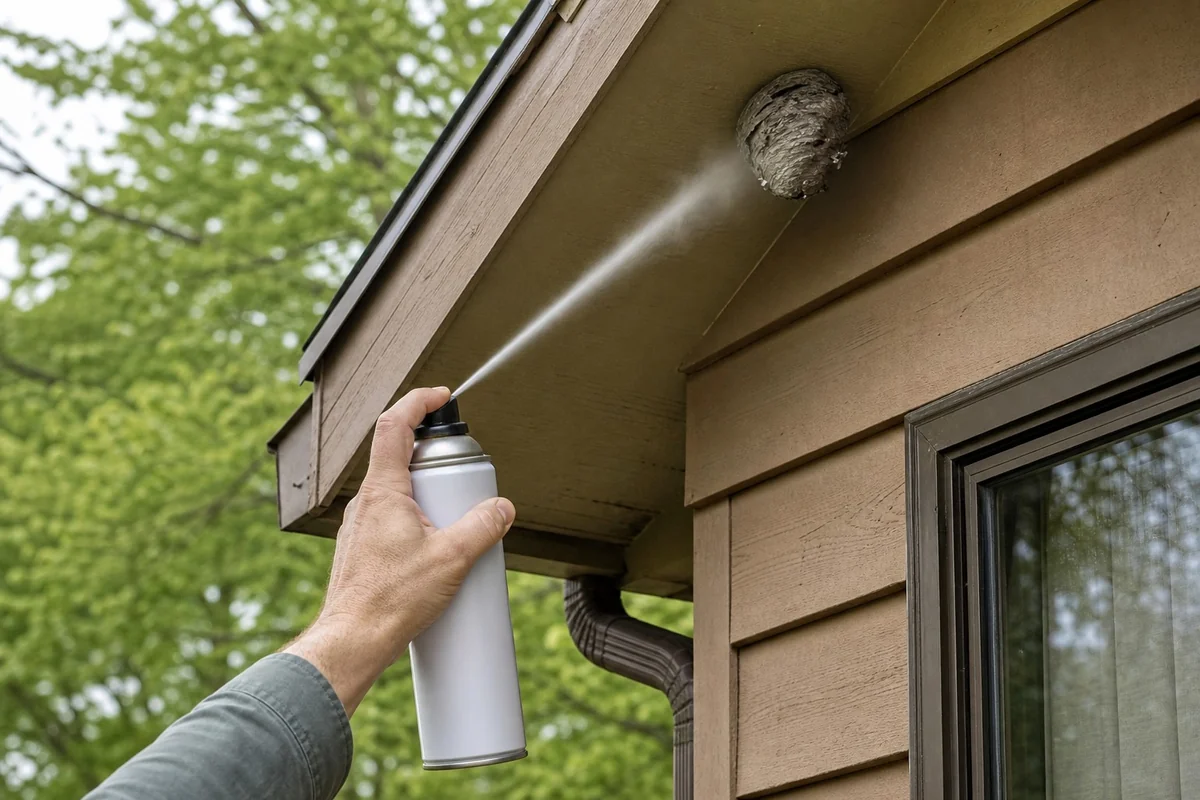
Yes, on exposed nests you can reach. University of California IPM's pest note on yellowjackets and other social wasps recommends an insecticide that shoots a long stream into the nest entrance and is labeled for treating yellowjacket nests. Some of these formulations reach up to 20 feet. That distance is the point: it lets you treat the nest without standing beside it.
Sprays work best on paper wasp nests under eaves and railings, on hornet nests hanging from branches and on small yellowjacket nests at a ground opening. They work poorly on nests hidden inside walls, ceilings or deep in the soil, where the spray never reaches most of the colony. UC IPM advises that hiring a pest control professional reduces risk, and that calling for help is easiest and safest when nests must be removed.
Our flying insect guides also cover fly and moth traps, and the wasp and hornet spray section collects our guides on specific nests and safety.
Identify your needs and get personalized recommendations
Exposed paper nest.
Ground opening.
Indoor nest or stray wasps.
Know Your Wasp and Its Nest
- Paper wasps: slender, long-legged wasps that build open, umbrella-shaped nests under eaves and railings. According to UC IPM, these nests rarely grow larger than an outstretched hand. Colonies hold about 15 to 200 wasps.
- Yellowjackets: stocky black-and-yellow wasps that often nest in rodent burrows or in wall and ceiling voids. Their colonies can reach 1,500 to 15,000 wasps, and they are the ones that crowd picnics in late summer.
- Bald-faced hornets: black-and-white wasps that build large, gray, football-shaped paper nests in trees and shrubs.
- Mud daubers: solitary wasps that build mud tubes; they rarely sting and usually need no treatment.
The type tells you how to treat it. Exposed paper wasp and hornet nests respond well to a jet spray. Ground nests usually need a spray followed by dust into the entrance. Wall void nests are best left to a professional, because blocking or spraying the entrance can drive wasps into the house.
Wasp Control Types Compared
| Type | How It Works | Best For | Limit |
|---|---|---|---|
| Jet aerosol | Long stream knocks down wasps and soaks the nest | Eaves, railings, branches | Outdoor only for most products |
| Foaming jet aerosol | Foam coats the nest and entrance | Exposed nests | Foam can drip and mark surfaces |
| Quick-knockdown professional aerosol | Fast-acting pyrethroid with residual activity | Indoor and outdoor nests | Shorter range |
| Insecticide dust with duster | Dust carried into the colony | Ground nests, cracks, wall gaps | Needs close approach |
| Plant-based aerosol | Essential oils kill on contact | Single wasps near people | Weak residual; staining reported |
We compared wasp products on reach, active ingredients, where they are labeled for use and what buyers report about kills, range and value. Our sources were the makers' listings, Amazon's review digests and UC IPM guidance; we did not test the products. We left out a plant-based spray whose buyers mostly report poor value, staining and oily residue, and listings with no buyer feedback to go on.
Best Wasp Sprays
Spectracide Wasp & Hornet Killer: Best Overall Wasp Spray
Spectracide's 18.5-ounce jet aerosol, sold here as a 12-pack, reaches nests up to 27 feet away and is made to eliminate the nest where wasps live and breed, per the maker.
- It is for outdoor use only, applied at sunrise or sunset when wasps are least active, per the maker.
- Buyers praise its range and the way it foams over the nest, and find it good value in bulk.
- Results are mixed for some buyers, who say it does not always kill the whole nest in one treatment.
Choose it if you deal with wasps every summer, under eaves, decks and play sets. The 12 cans last several seasons; share some with neighbors or keep one in the garage and one by the back door.
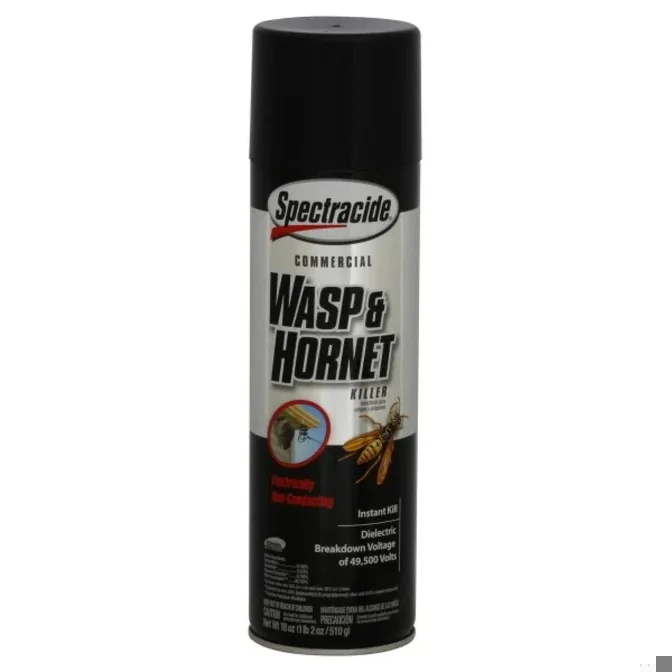
Spectracide Wasp & Hornet Killer Aerosol 18.5 oz, 12 Pack
Best for: Long-range nests under eaves and decks
- ✓Reaches up to 27 feet, per the maker
- ✓Long range and good foam, per buyers
- ✓Good value in bulk, per buyers
- −Mixed effectiveness, per buyers
- −Outdoor use only
Specifications (1)
- Item Form
- Spray
Raid Wasp & Hornet Killer: Best Budget Wasp Spray
Raid's 2-pack of 14-ounce cans uses prallethrin and cypermethrin and sprays up to 22 feet, per the maker.
- It kills paper wasps, yellowjackets, mud daubers and bald-faced hornets on contact, per the maker.
- It is electrically non-conducting up to 32,500 volts, per the maker, which matters near light fixtures and wiring.
- Buyers report it eliminating wasps and whole nests; some say the effect does not last.
Choose it for one or two nests a season, especially near porch lights and electrical boxes. Stand back at full range and aim at the nest opening.
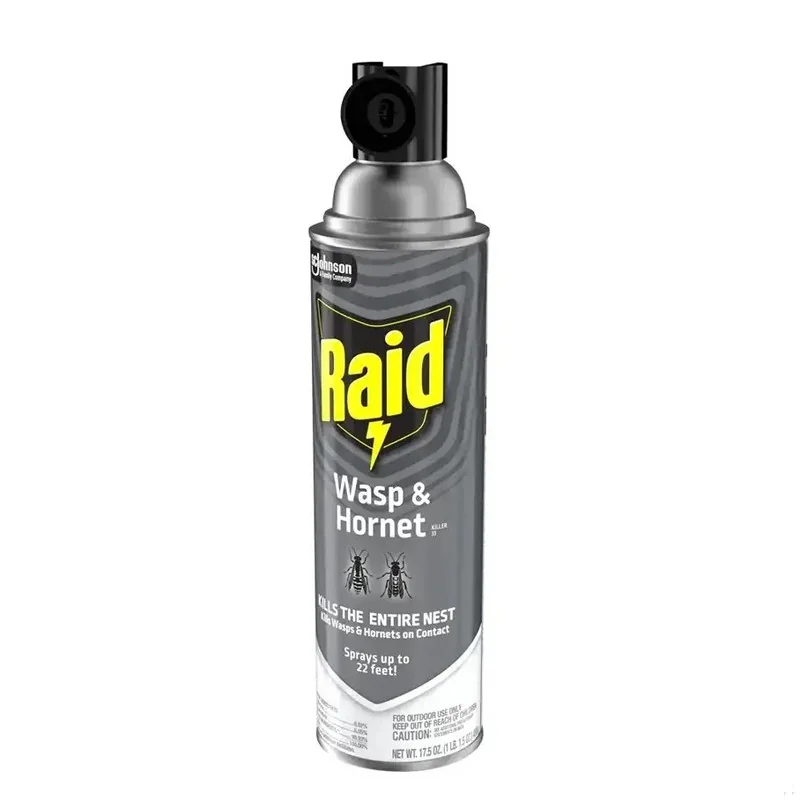
Raid Wasp & Hornet Killer 14 oz, 2 Count
Best for: A budget can safe near electrical fixtures
- ✓Sprays up to 22 feet, per the maker
- ✓Non-conducting up to 32,500 volts, per the maker
- ✓Kills whole nests, per buyers
- −Effect does not last, per some buyers
- −Shorter range than Spectracide
Specifications (1)
- Active Ingredients
- Prallethrin, Cypermethrin
BASF PT Wasp-Freeze: Best Professional Knockdown Spray
BASF's PT Wasp-Freeze is a 14-ounce professional aerosol with 0.1% prallethrin that knocks wasps down almost instantly and leaves residual activity on the nest, per the maker.
- It is labeled for indoor or outdoor use and also lists yellowjackets and black widow and brown recluse spiders, per the maker.
- It reaches up to 15 feet, shorter than consumer cans, and may stain asphalt and shingles, per the maker.
- Buyers report entire nests killed on contact; many say the cans run out quickly.
Choose it for a wasp that gets inside, a nest in a shed or garage, or anywhere a fast knockdown matters more than range. Read the label for indoor directions and ventilate afterward.

BASF PT Wasp-Freeze Insecticide 14 oz
Best for: Fast knockdown indoors and out
- ✓Instant knockdown, per the maker
- ✓Indoor and outdoor label
- ✓Kills nests on contact, per buyers
- −Range up to 15 feet
- −Cans run out quickly, per buyers
Specifications (1)
- Active Ingredients
- Prallethrin 0.1%
Delta Dust With Puffer Duster: Best for Ground and Wall Gaps
This 1-pound bottle of Delta Dust comes with a bellows puffer for blowing insecticide dust into nest openings, cracks and voids, per the listing.
- Dust stays active in dry spaces and is carried into the colony by wasps walking through it.
- Buyers find it effective and fast; dust quality and puffer durability are mixed.
- It requires getting close to the entrance, so protective clothing is essential.
Choose it for a yellowjacket nest in a ground hole or a small gap in siding, applied at night after the jet spray has knocked down the guards at the entrance. Leave the entrance open so returning wasps walk through the dust.
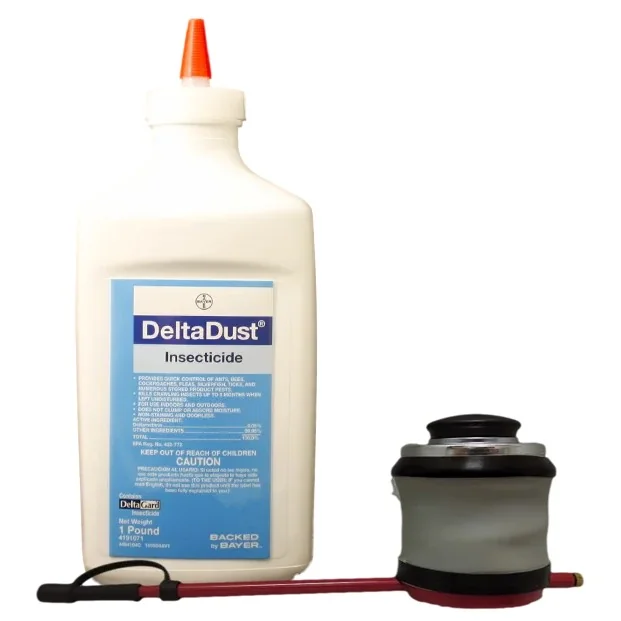
Delta Dust 1 lb With Puffer Bellow Hand Duster
Best for: Ground nests and small wall gaps
- ✓Effective and fast, per buyers
- ✓Stays active in dry spaces
- ✓Puffer included
- −Requires close approach
- −Puffer durability mixed, per buyers
Specifications (2)
- Specification Met
- EPA
- Included Components
- 1 Delta Dust 1lb + 1 puffer
- Spectracide Wasp & Hornet Killer wins for: long-range nests under eaves and decks
- Raid Wasp & Hornet Killer wins for: a budget can safe near electrical fixtures
- BASF PT Wasp-Freeze wins for: fast knockdown indoors and out
- Delta Dust with Puffer wins for: ground nests and small wall gaps
How to Spray a Wasp Nest Safely
- Check for allergies: anyone with a history of severe reactions should not treat nests; UC IPM notes some people suffer life-threatening allergic responses.
- Wait until dark: UC IPM notes wasps are most likely to be in the nest at night.
- Dress for it: cover your whole body, including a veil over your face and gloves, as UC IPM advises.
- Use a red light: wasps see red poorly, so cover a flashlight with red film, and never shine it straight at the nest.
- Stand at full range: upwind if possible, and spray the nest opening until it is soaked.
- Walk away: calmly, along your planned route, and keep people and pets away until the next day.
- Check after a day or two: UC IPM warns that agitated wasps may linger near the nest even the next day; retreat if activity continues.
- Remove the nest: once there is no activity, knock it down and bag it.
Never plug the entrance to a nest in a wall, since trapped wasps can chew through drywall into the house. For wall and ceiling nests, call a professional.
Wasp Myths: Dish Soap, WD-40 and Dryer Sheets
Soapy water can kill a wasp it soaks, but only at close range, which is exactly where you do not want to be with a nest. WD-40 and other lubricants are not labeled for wasps and are flammable; using them is unsafe and against label law for pesticides. Dryer sheets and decoy nests are often suggested as repellents, but there is little evidence they keep wasps away for long. Flying insect sprays that are not labeled for wasp nests usually lack the jet range to reach a nest safely.
For lasting relief in the yard, UC IPM suggests placing yellowjacket traps between the area you want to protect and the nesting sites, away from where people gather, and keeping food and sweet drinks covered outdoors in late summer.
Common Questions About Wasp Sprays
Which wasp spray sprays the farthest?
Which wasp spray sprays the farthest?
Among the sprays we compared, Spectracide's jet aerosol lists the longest reach, up to 27 feet, followed by Raid at up to 22 feet. Real range depends on wind and how full the can is, so stand at the edge of the stated range, not beyond it.
How do I permanently get rid of wasps in my yard?
How do I permanently get rid of wasps in my yard?
Treat or remove active nests, then reduce what draws wasps: cover food and sweet drinks outdoors, keep trash lids tight and pick up fallen fruit. Check eaves and play sets in spring, when new nests are small and easy to remove.
Does Hot Shot flying insect killer kill wasps?
Does Hot Shot flying insect killer kill wasps?
A general flying insect spray may kill a wasp it hits, but it is not designed to reach a nest from a safe distance. Use a product labeled for wasp and hornet nests, which shoots a long jet stream.
What is a wasp's weakness?
What is a wasp's weakness?
Cold and darkness. Wasps slow down at night and in cool weather and return to the nest, which is why treating at dusk or after dark is safest and most effective.
What should I do if I get stung?
What should I do if I get stung?
Move away from the nest, wash the sting with soap and water and apply a cold pack. Seek emergency care immediately for swelling of the face or throat, trouble breathing or dizziness, which can signal a serious allergic reaction.
Which One Should You Buy?
Spectracide Wasp & Hornet Killer is the wasp spray to buy for most homes. Its 27-foot jet lets you treat nests under eaves and decks from a safe distance, and the foaming spray coats the nest well.
Choose Raid's 2-pack for a budget can near electrical fixtures, BASF's PT Wasp-Freeze for fast knockdown indoors or in sheds, and Delta Dust for ground nests and small wall gaps. With any of them, treat at night in full protective clothing, and call a professional for nests inside walls or if anyone in the home is allergic.
Before you buy, look at the nest from a distance and identify the wasp, since that decides whether you need a jet spray, dust or a professional.