
How to Get Rid of Mice in the Attic
How to get rid of mice in the attic: signs to look for, how to trap along joists and eaves, sealing the roofline and cleaning droppings and insulation safely.
The best way to get rid of mice in the attic is to trap them along the joists and eaves where they travel, seal the gaps at the roofline that let them in, and clean up droppings and soiled insulation safely. Mice in an attic are common because it is warm, quiet and close to gaps in the roof and walls, so sealing matters as much as trapping.
Is It Common for Mice to Be in the Attic?
Yes. An attic gives mice warmth, soft insulation to nest in and little human traffic, and it connects to the rest of the house through wall cavities, plumbing chases and gaps around the chimney or vent pipes. Mice often move up from the walls and basement, or climb the outside of the house and slip in at the roofline.
Activity usually rises as the weather cools and mice look for shelter. Attic mice are part of a broader rodent problem, so our overview of mouse and rat control covers the traps, baits and repellents that apply across the house.
Because many attic mice arrive from outside, the yard matters too. Trees touching the roof, woodpiles against the house and gaps in the foundation all feed an attic problem, and our guide to getting rid of mice outside covers the outdoor side.
Signs of Mice in the Attic
You rarely see attic mice, but you hear them and find what they leave behind. The most common clue is scratching or light scampering overhead at night, since mice are mostly active after dark.
- Droppings along the eaves, on top of joists and near the attic hatch.
- Tunnels and nests in insulation, often near the edges where the roof meets the walls.
- Gnaw marks on wood, cardboard boxes, wiring and flexible ducts.
- A musky smell in a closed attic, which gets stronger with a larger infestation.
Heavier footsteps and larger droppings point to rats rather than mice. Do rats stay in the attic during the day? Often yes: UC IPM notes rats are mostly active at night, so they rest in nests by day and travel after dark, much like mice. The mice in attics and garages section covers both.
How Mice Get Into the Attic
Knowing the route tells you where to seal. Attic mice arrive two ways: from outside at the roofline, or from inside the house through the walls.
- Up the outside: mice climb rough siding, brick corners, downspouts and utility lines, then slip in at gaps in the eaves, soffits and vents.
- Across from trees: branches that touch or overhang the roof act as bridges, especially for rats.
- Up through the walls: mice already in the basement or kitchen travel up wall cavities, plumbing chases and gaps around ducts.
- Through the garage: an attached garage often shares an attic space or wall cavity with the house.
Droppings in the basement or kitchen as well as the attic usually mean mice are moving through the walls, so the inside openings need sealing too. Droppings only in the attic, concentrated along the eaves, point to an entry at the roofline.
Attic Mouse Removal Methods Compared
Not every method suits an attic, where heat, insulation and awkward access change the rules. The table compares the common options.
| Method | Works in an Attic? | Main Drawback |
|---|---|---|
| Snap traps | Yes, the main method | Need daily checks and safe access |
| Electronic traps | Yes, on flat boards | Few per pack; batteries |
| Live traps | Possible | Mice suffer in attic heat if not checked often |
| Poison bait stations | Last resort | Mice often die in walls or insulation, causing odor |
| Mothballs | No | Toxic fumes and not labeled for rodent control |
| Ultrasonic repellers | No | Insulation and framing block sound; little evidence they work |
Do mothballs repel mice? Not in any reliable way. They are made for clothes moths in sealed containers, and their fumes drift into living spaces below the attic. If the mice are also using your garage, our guide to getting rid of mice in the garage covers that space separately.
How to Trap Mice in the Attic
Attic mice travel along the tops of joists, the edges of the floor where the roof meets the walls, and along ducts and pipes. Set traps on those routes rather than out in the middle of the insulation.
- Plan safe access. Walk only on joists or a board laid across them; stepping between joists can go through the ceiling below.
- Make flat platforms. Lay short boards across the joists or on the insulation so traps sit level and stable.
- Place traps on the runways. Put snap traps along the eaves, beside droppings and next to pipes and ducts, with the bait end toward the wall or rafter.
- Bait lightly. Use a pea-sized dab of peanut butter, or a tuft of cotton in colder months when mice gather nesting material.
- Check every day. Attic heat speeds up decay and odor, so empty traps each morning with gloves.
- Keep going. Leave traps out until a full week passes with no catches and no fresh droppings.
For tunnels under the insulation, set traps at the entrances where the tunnels meet a joist or the eaves, rather than digging into the insulation itself.
Sealing the Attic and Roofline
Trapping removes the mice that are in the attic; sealing stops the next ones. The CDC's guide to sealing up rodent entry points lists the roof among the rafters, gables, eaves and soffits as places to check outside, and notes mice can fit through a hole about the width of a pencil.
- Eaves and soffits: gaps where the roof overhang meets the wall, and loose or damaged soffit panels.
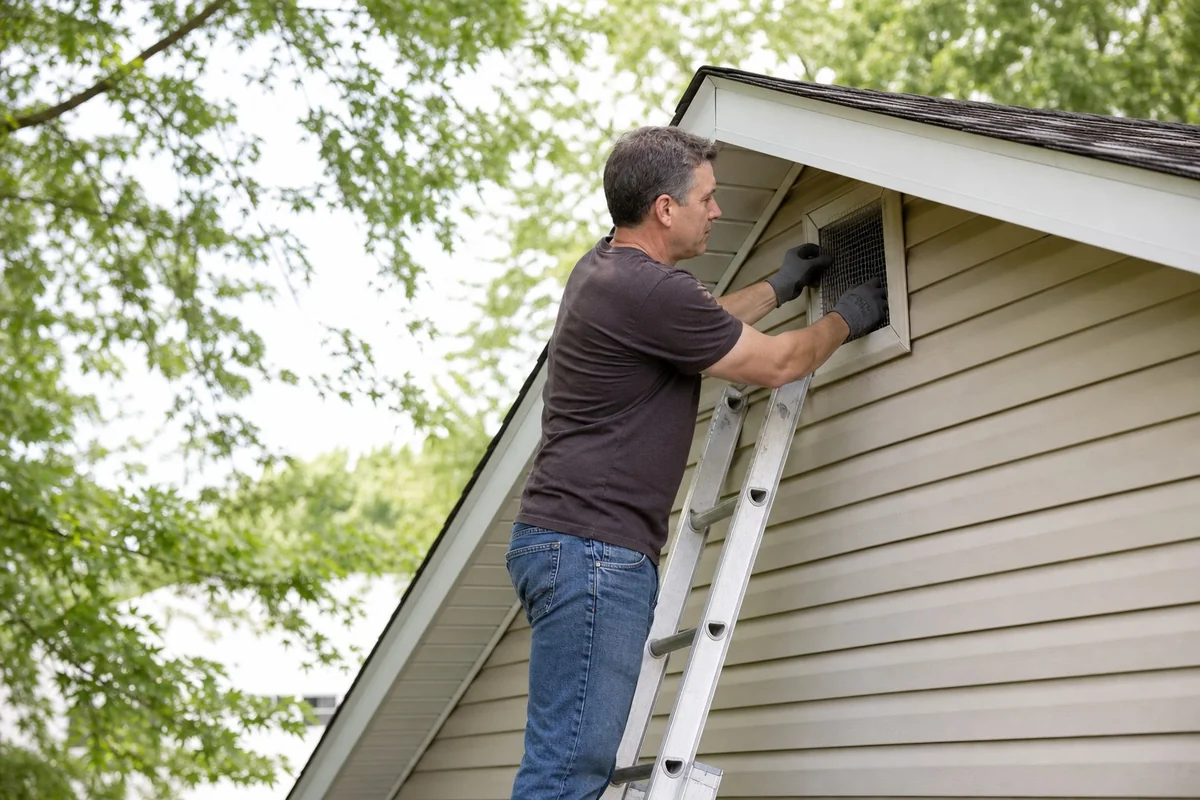
- Gable and roof vents: torn or missing screens; cover them with sturdy metal mesh, not plastic screen.
- Pipe and chimney openings: gaps around plumbing vents, flues and the chimney.
- Inside the attic: openings where wiring, ducts and pipes enter from the walls below.
Pack small holes with steel wool held in with caulk or spray foam, and cover larger openings with hardware cloth or metal flashing. Trim tree branches that touch or overhang the roof, since mice and rats use them as bridges. Roof work is risky, so leave high or steep sections to a roofer or pest professional.
Cleaning Up Droppings and Insulation Safely
Attic cleanup carries more risk than cleaning a kitchen shelf, because dust and insulation are easily stirred into the air in a closed space. The CDC's hantavirus prevention page explains that when fresh urine, droppings or nesting material from an infected rodent are stirred up, the virus can get into the air.
- Ventilate first: open the attic hatch and any windows or vents, and stay out while it airs.
- Wear rubber or plastic gloves, and avoid sweeping or vacuuming droppings.
- Spray droppings and nesting material with a bleach solution or disinfectant until soaked, wait, then pick them up with paper towels.
- Bag everything, including dead mice and used traps, and wash your hands after removing gloves.
What diseases do mice carry? The CDC lists hantavirus, lymphocytic choriomeningitis and salmonellosis among the diseases rodents can spread, mainly through their urine, droppings, saliva and nesting materials. Insulation that is heavily soiled with droppings and nests is best replaced by a professional with the right protective equipment, rather than handled yourself.
Protecting What You Store in the Attic
Mice shred cardboard, fabric and paper for nests and chew whatever is in their way, so stored belongings are often the first casualties. A few changes make the attic less useful to them and limit damage while you trap.
- Swap cardboard for plastic: move stored items into hard plastic bins with tight lids.
- Keep food out: never store birdseed, pet food, grass seed or holiday candy in the attic.
- Raise items: set bins on boards across the joists rather than directly on insulation, where mice tunnel.
- Check wiring: look for chewed insulation on electrical cables near nests; damaged wiring is a fire risk and needs an electrician.
Fewer nesting materials and no food also make your traps more appealing, because the bait becomes one of the few things worth investigating.
When to Call a Professional
Many attic mouse problems are a weekend job, but some situations are worth handing off. Call a licensed pest professional or roofer when the entry points are on a steep or high roof, when insulation is heavily soiled and needs removal, when you find chewed wiring, or when catches continue after several weeks of trapping and sealing.
Ask any professional to find and seal the entry points, not only to set traps or bait. Without sealing, a clean attic fills up again with the next group of mice looking for shelter.
- Ask what they will seal: a written list of the entry points they found and the materials they will use.
- Ask about traps versus bait: in an attic, traps avoid mice dying out of reach in walls or insulation.
- Ask about follow-up: a return visit to check traps and confirm no new activity.
- Ask about insulation: whether soiled insulation will be removed and replaced, and how.
Common Questions About Mice in the Attic
What can I put in the attic to get rid of mice?
What can I put in the attic to get rid of mice?
Snap traps on boards along the joists and eaves are the most reliable choice, baited lightly with peanut butter or nesting material. Avoid mothballs and loose poison, and pair trapping with sealing the roofline gaps the mice use.
How can I tell mice from squirrels in the attic?
How can I tell mice from squirrels in the attic?
Timing and sound are the best clues. Mice make light scratching and scurrying sounds mostly at night, while squirrels are active in the daytime, especially early morning and late afternoon, and sound heavier. Squirrels also leave larger droppings and often chew larger entry holes at the roofline.
Will attic mice leave in the summer?
Will attic mice leave in the summer?
Not reliably. Attic heat can push them toward cooler spots like wall cavities, but they keep using the house as long as there is food and shelter. Trap and seal rather than waiting for the season to change.
Do I need to replace attic insulation after mice?
Do I need to replace attic insulation after mice?
Only if it is heavily soiled with droppings, urine or nests, or flattened by tunnels. Light contamination can be treated by soaking droppings with disinfectant and removing them; heavy contamination is best removed by a professional with protective equipment.
Key Takeaways
An attic is a warm, quiet shelter connected to the rest of the house, which is why mice settle there and why one fix is never enough. Traps on the joists remove the current mice, sealed eaves, vents and wall openings stop the next ones, and plastic bins with no food stored leave little to nest in.
Safety shapes the job: walk only on joists, never sweep or vacuum droppings in a closed space, and leave steep roof work, chewed wiring and heavily soiled insulation to professionals.
If mice are also showing up in other parts of the house, the next step is a whole-home trapping and sealing plan.