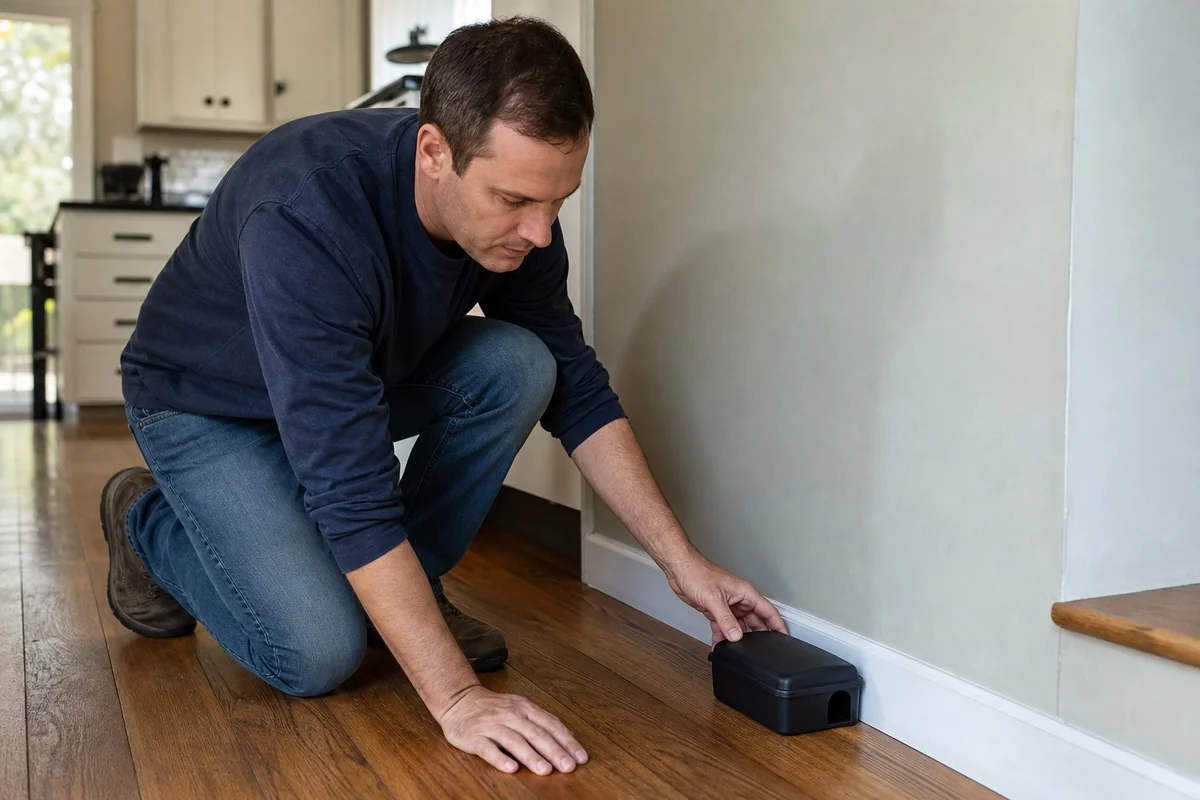

How to Get Rid of Mice in the House: A Whole-House Plan
The best way to get rid of mice in a house: map every room with droppings, trap them all at once, store food sealed and seal pencil-sized gaps outside.
The best way to get rid of mice in a house is to treat the whole house as one job: find every room with droppings, set snap traps along the walls in each of them, store all food in sealed containers, and seal the gaps around the outside where mice get in. Trapping one room while mice live in three never finishes the job.
Why a House-Wide Plan Beats One Room at a Time
Mice in a house rarely stay in the room where you first see them. A kitchen sighting often means a nest in a wall cavity, under a bathroom vanity or in the basement, with mice traveling along hidden runways between food and shelter. Trap only the kitchen and the ones nesting elsewhere keep going.
House mice also stay close to home. UC IPM's house mouse guide notes they seldom travel more than 30 feet from their nest and food, so separate clusters of droppings on different floors usually mean separate groups of mice, each needing its own traps. Our main guide on how to get rid of mice covers the step-by-step method; this article shows how to apply it across a whole house.
Where Mice Hide in a House
Do a slow walk-through with a flashlight before you buy a single trap. These are the places mice use most in a typical house.
- Kitchen: behind and under the stove and refrigerator, under the sink, the back of lower cabinets and the pantry.
- Bathrooms and laundry: under vanities and behind washers, where pipes run through the wall.
- Basement and crawl space: along the top of the foundation wall, around the water heater and furnace, and in stored boxes.
- Attic: along the edges where the roof meets the walls and in insulation.
- Garage: around stored pet food, birdseed, grass seed and cardboard boxes.
- Inside walls: scratching at night, often near pipes or wiring that run between floors.
Note each spot with droppings, gnaw marks or nesting material. That list becomes your trap map.
A Room-by-Room Trapping Plan
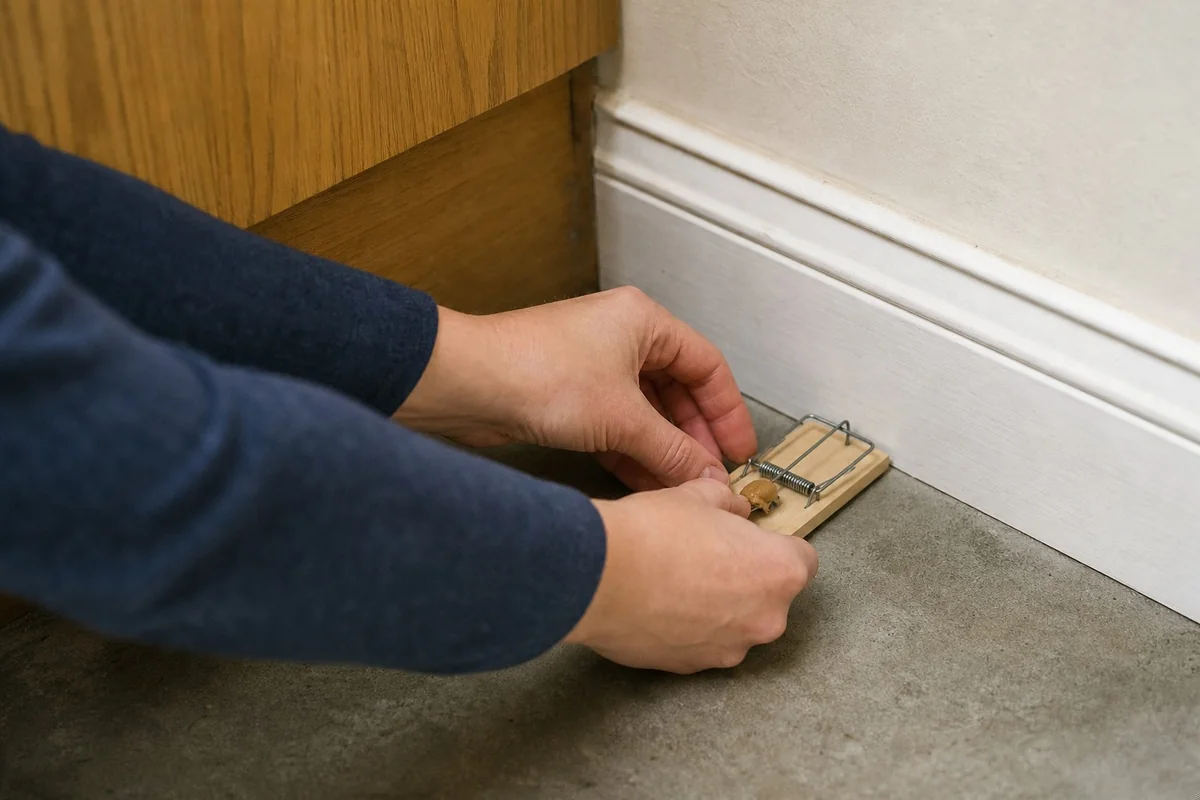
With your map in hand, set traps in every active area on the same night, so mice cannot simply shift to an untrapped room. UC IPM advises spacing traps no more than about 10 feet apart where mice are active and using enough traps to keep the trapping period short.
| Area | Where to Set Traps | What to Watch For |
|---|---|---|
| Kitchen and pantry | Behind appliances, back of cabinets | Pets and children; use enclosed traps where they reach |
| Bathrooms and laundry | Under vanities, behind machines | Damp floors; check traps daily |
| Basement and crawl space | Along foundation walls and stored items | Clutter giving mice detours around traps |
| Attic | Along the eaves and joists | Heat and access; check traps every morning |
| Garage | Along walls, near stored seed and pet food | Food that competes with the bait |
Each room's details, from food storage in the kitchen to the attic and garage, have their own guides in the getting rid of mice section.
Will Mice Leave a House if There Is No Food?
Rarely on their own. Removing food makes your traps more attractive and slows breeding, but a house still offers warmth, shelter and water, and mice eat whatever is available. They will scavenge crumbs, pet food, paper and even soap before they move out.
That is why food storage is a support step rather than a solution. Store pantry food, pet food and birdseed in sealed containers, clean up crumbs, and pick up pet bowls at night, but keep trapping until the signs stop. With less food around, the bait on your traps becomes the easiest meal in the house, and catches usually pick up within a few nights.
Sealing the House So Mice Stay Out
Every mouse you catch can be replaced by another walking in through the same gap, so sealing is what makes the result permanent. Mice fit through openings about the width of a pencil, so small gaps matter.
- Foundation and siding: cracks, gaps where siding meets the foundation, and weep holes.
- Utility entries: holes around pipes, cables, dryer vents and air conditioner lines.
- Doors: worn sweeps under exterior doors and the garage door seal.
- Roofline: gaps at the eaves, soffits and gable vents.
Pack small holes with steel wool and seal them with caulk or spray foam; cover larger openings with hardware cloth or metal sheeting. Do the sealing while you trap, not after, so the catches stop instead of continuing for weeks.
Common Questions About Getting Rid of Mice in the House
How quickly do mice reproduce in a house?
How quickly do mice reproduce in a house?
Quickly. According to UC IPM, a female may have 5 to 10 litters of about 5 or 6 pups, young are born 18 to 21 days after conception and mature in 5 to 6 weeks. A few mice can become a large group within a season, which is why trapping should start right away.
Is it safe to sleep in a house with mice?
Is it safe to sleep in a house with mice?
Generally yes, since house mice avoid people and are active while you sleep mostly in walls, cabinets and storage areas. The real risk is contamination, so keep food sealed, clean droppings with disinfectant and gloves, and trap promptly rather than living with them.
Should I hire an exterminator for mice in the house?
Should I hire an exterminator for mice in the house?
Consider one if droppings keep appearing after two to three weeks of steady trapping and sealing, if you cannot reach entry points on the roof or in a crawl space, or if you also find signs of rats. Many homeowners clear a typical infestation themselves.
Do mice come back every winter?
Do mice come back every winter?
They often try, because mice move indoors as the weather cools. A house with sealed gaps and stored food gives them little reason or way to get in, so recheck seals and set a few traps in the garage or basement each fall.
Key Takeaways
A house is cleared faster when you treat it as a network of runways rather than a single problem room. The nightly trap list tells you where the nest is, and every room with droppings gets traps the same night.
Food storage helps, but sealing the outside is what makes the result last, so work on gaps while the traps run. Most houses can be cleared in two to three weeks; if droppings keep appearing after that, look for a missed entry point or call a licensed pest professional.
Tonight, walk the house with a flashlight, mark every spot with droppings, and set your first traps in each of them.
Related Articles
How to Get Rid of Mice Overnight: A Before-Dark Plan
You can catch most active mice in one night: remove food, set snap traps in pairs along walls, bait lightly and block gaps. What works overnight and what does not.
How to Get Rid of Mice in an Apartment
How to get rid of mice in an apartment: report it in writing, store food sealed, trap on the runways, seal gaps in your unit and get the building involved.
How to Get Rid of Mice: A Step-by-Step Plan That Works
How to get rid of mice for good: find their runways, set snap traps the right way, remove food, seal pencil-sized gaps and clean up droppings safely.
How to Get Rid of Mice Fast: A One-Week Plan
The fastest way to get rid of mice in a house: many snap traps at once, no food left out and gaps sealed in the first days. A one-week plan and what slows it down.